Coriolis Technologies
Three animated explainers for a trade-data company, making the mechanics of trade finance legible to the people who fund it.
Objective
Coriolis Technologies sells trade data. The hard part of selling trade data is not the data; it is that the thing the data describes is invisible.
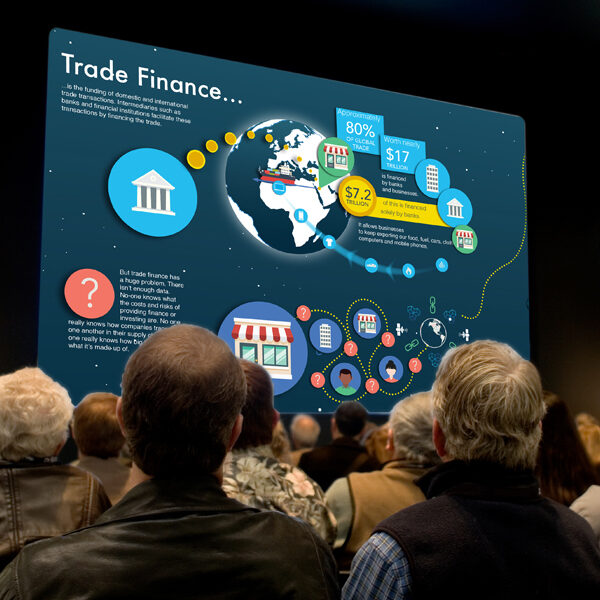
Trade finance funds roughly eighty per cent of global trade and almost nobody outside it can describe how. A bank pays a supplier so that goods can move before anyone has been paid for them. There is no object to point at, no photograph of it happening, and the vocabulary, letters of credit, supply chain finance, documentary collections, is a wall to anyone who hasn't already worked in it.
So the brief was explanation before persuasion. An audience that cannot picture the problem will not buy the instrument that measures it.
Creative response
Design, illustration and animation across the set, delivered as an outside supplier to Coriolis.
- Trade Finance. How trade is funded, why the funding gap exists, and what is missing from the data
- Digital Trade. Trade as it moves through digital channels
- Traditional Trade. The established model, as the counterpoint the other two are measured against
- A shared visual system. One illustrative language across all three, so the set reads as a single argument rather than three films
- Strategic Trade. A fourth film, storyboarded in full, script, frame-by-frame direction and a library of twenty-three custom vector assets
The storyboard
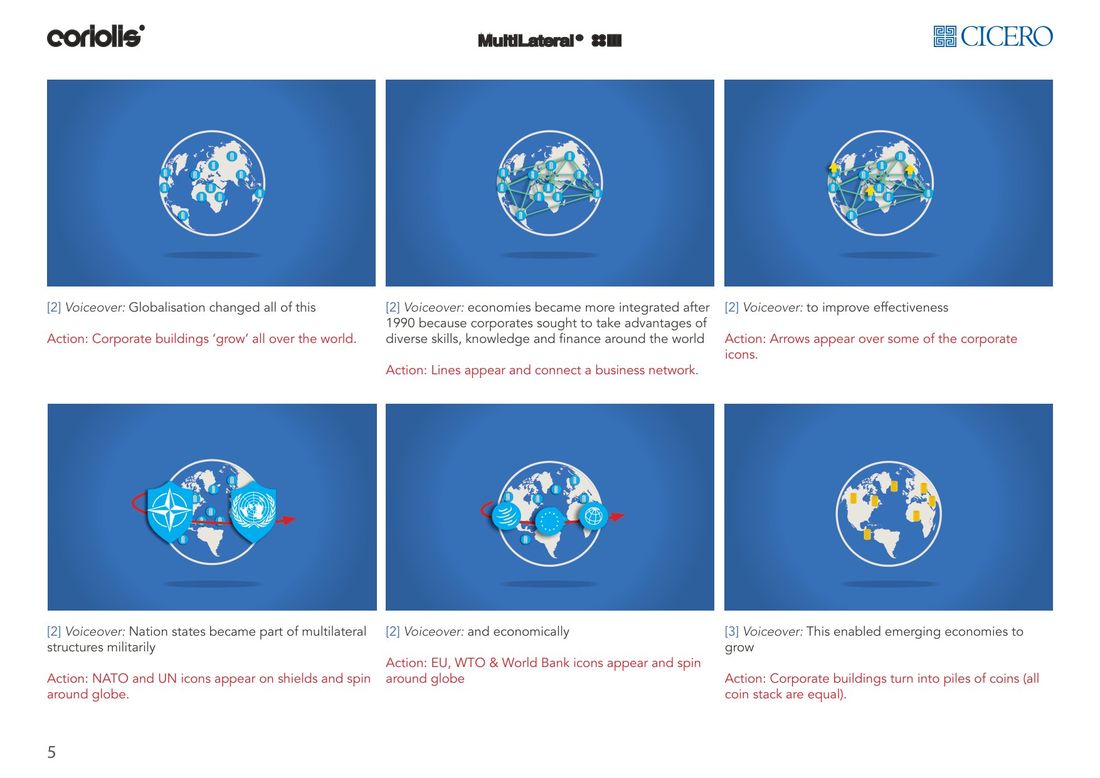
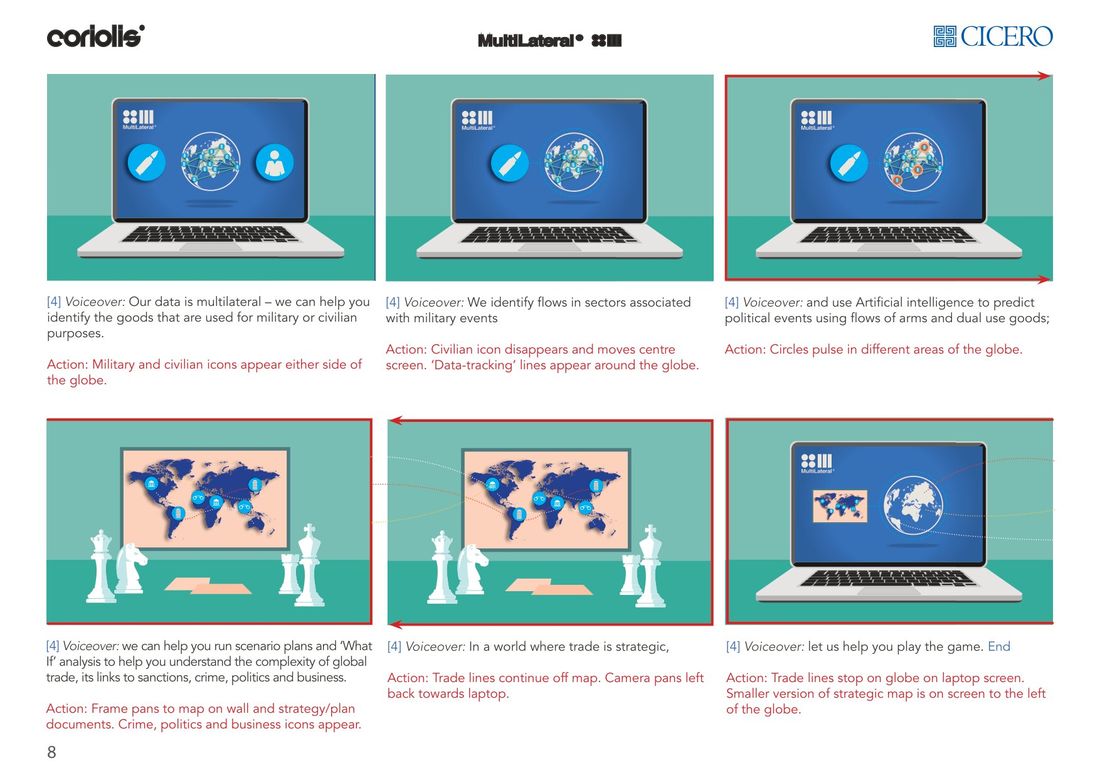
The Strategic Trade storyboard pairs every voiceover line with a corresponding animation instruction. Every frame carries the voiceover line it sits under and the animation instruction beneath it: corporate buildings grow all over the world, NATO and UN icons appear on shields and spin around globe, coin stacks reappear on US & China and a single coin flips between the two.
Writing the action against the line, frame by frame, is what lets a client sign off motion before any of it exists. The twenty-three vector assets built alongside it, flags, oil, spices, tanks, wheat, the WTO, the UN, the World Bank, are the reason four films could share one visual language instead of converging on it by accident.
Why a set, not a film
Three animations covering three overlapping subjects is a harder problem than one film covering all of them, and a better answer.
A single explainer forces every viewer down the same path at the same depth. A set lets the company put the right two minutes in front of the right person, and lets the same illustrative system do the work of tying them together, so a viewer arriving at the second film already knows how to read it.
- Trade Finance. How trade is funded, why the funding gap exists, and what is missing from the data
- Digital Trade. Trade as it moves through digital channels
- Traditional Trade. The established model, as the counterpoint the other two are measured against
- A shared visual system. One illustrative language across all three, so the set reads as a single argument rather than three films
- Strategic Trade. A fourth film, storyboarded in full, script, frame-by-frame direction and a library of twenty-three custom vector assets
The storyboard
The Strategic Trade board is the clearest record of how the set was made. Every frame carries the voiceover line it sits under and the animation instruction beneath it, corporate buildings grow all over the world, NATO and UN icons appear on shields and spin around globe, coin stacks reappear on US & China and a single coin flips between the two.
Why a set, not a film
Watch
The work
Source: krismakuch.co.uk